Imagine a surgeon preparing for an IOL (Intraocular Lens) replacement surgery.
The patient has waited weeks. The team is ready.
But the required lens isn’t available.
What looks like a simple inventory issue is actually a complex failure across:
- Demand forecasting
- Production planning
- Supply chain coordination
- Data integration
In MedTech, these aren’t operational gaps. They directly impact patient care.
The Reality of Today’s MedTech Supply Chains
The MedTech industry has always operated under pressure—tight regulations, critical product availability, and zero margin for error.
But today’s challenges are different:
- Global disruptions
- Volatile demand
- Fragmented systems
- Increasing compliance requirements
Most supply chains today are still: 1. Reactive instead of predictive 2. Siloed instead of connected
And there’s a deeper issue we often ignore: Who gets access—and who doesn’t?
From Optimization to Access
Companies like Medtronic have already started transforming their supply chains using AI.
By breaking data silos and improving planning, they now proactively manage demand at scale—across millions of SKUs and global distribution networks.
This is powerful.
But the real question is : Can AI ensure access beyond urban hospitals—to underserved communities?
At GrowIT, this is where the real opportunity lies.
Demand Forecasting That Works—for Everyone
AI is already improving forecasting for companies like Amgen and Gilead—reducing stockouts and improving planning accuracy.
But most models optimize for efficiency.
What if we optimized for impact?
Imagine combining:
- Clinical demand
- Regional healthcare gaps
- Socioeconomic signals
- Rural vs urban accessibility
AI can move from predicting demand → to prioritizing need.
Intelligent Supply Chains, Real-World Outcomes
AI-driven inventory optimization is delivering significant cost savings across healthcare organizations.
But the real question is not cost.
It’s this:
- Are critical supplies reaching the last mile?
- Are we reducing waste where resources are limited?
- Are we improving outcomes for those who need it most?
Efficiency matters. But impact matters more.
Beyond Silos : Building Connected Ecosystems
Companies like Sanofi and Alcon are leveraging AI to build more connected supply chains—improving coordination and decision-making.
But the next leap is bigger.
We need ecosystems that:
- Integrate public health systems
- Support community-level healthcare delivery
- Enable real-time feedback from the ground
This is where AI moves from enterprise optimization → real-world execution.
What the Future Looks Like
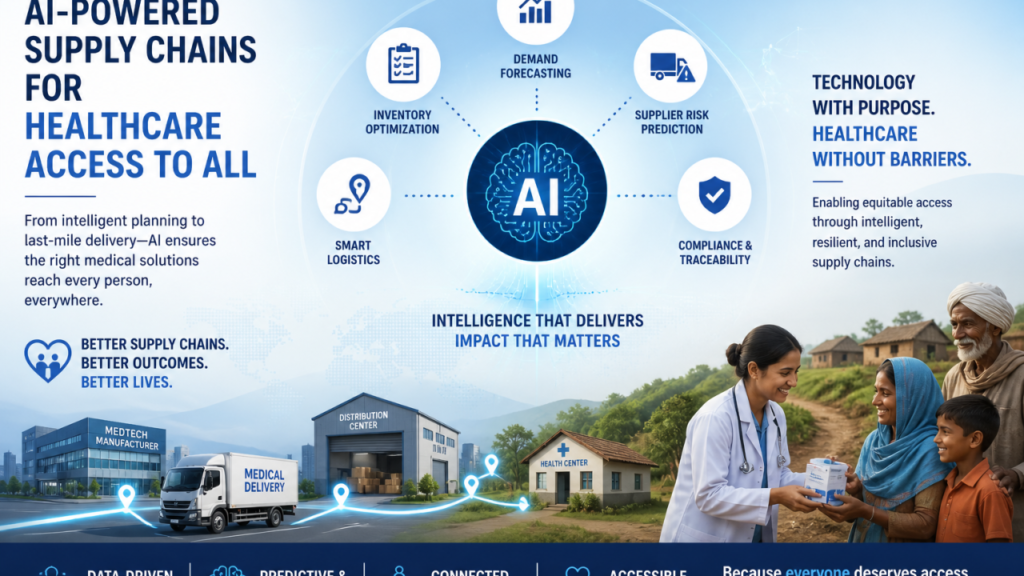
AI is transforming MedTech supply chains into systems that are:
- Predictive
- Resilient
- Cost-efficient
But the real transformation is this:
👉 Inclusive 👉 Accessible 👉 Impact-driven
The winners will not just optimize supply chains. They will redefine them around access and trust.
Final Thought
In MedTech, supply chains are not just infrastructure. They are a direct extension of patient care.
AI is enabling a shift:
Reactive logistics → Intelligent systems → Meaningful impact
At GrowIT, we believe:
Technology should not just make systems smarter. It should make them fairer, more accessible, and more human-centric.
Because in the end, innovation matters only when it reaches the people who need it most.